 TRISA
TRISATransTem Regional Initiative
TRISA – Technology Transfer for Sustainable Protein and Circular Agriculture
Transferring knowledge from Serbia and establishing a Tenebrio molitor Pilot Breeding Centre in Ulcinj, Montenegro.
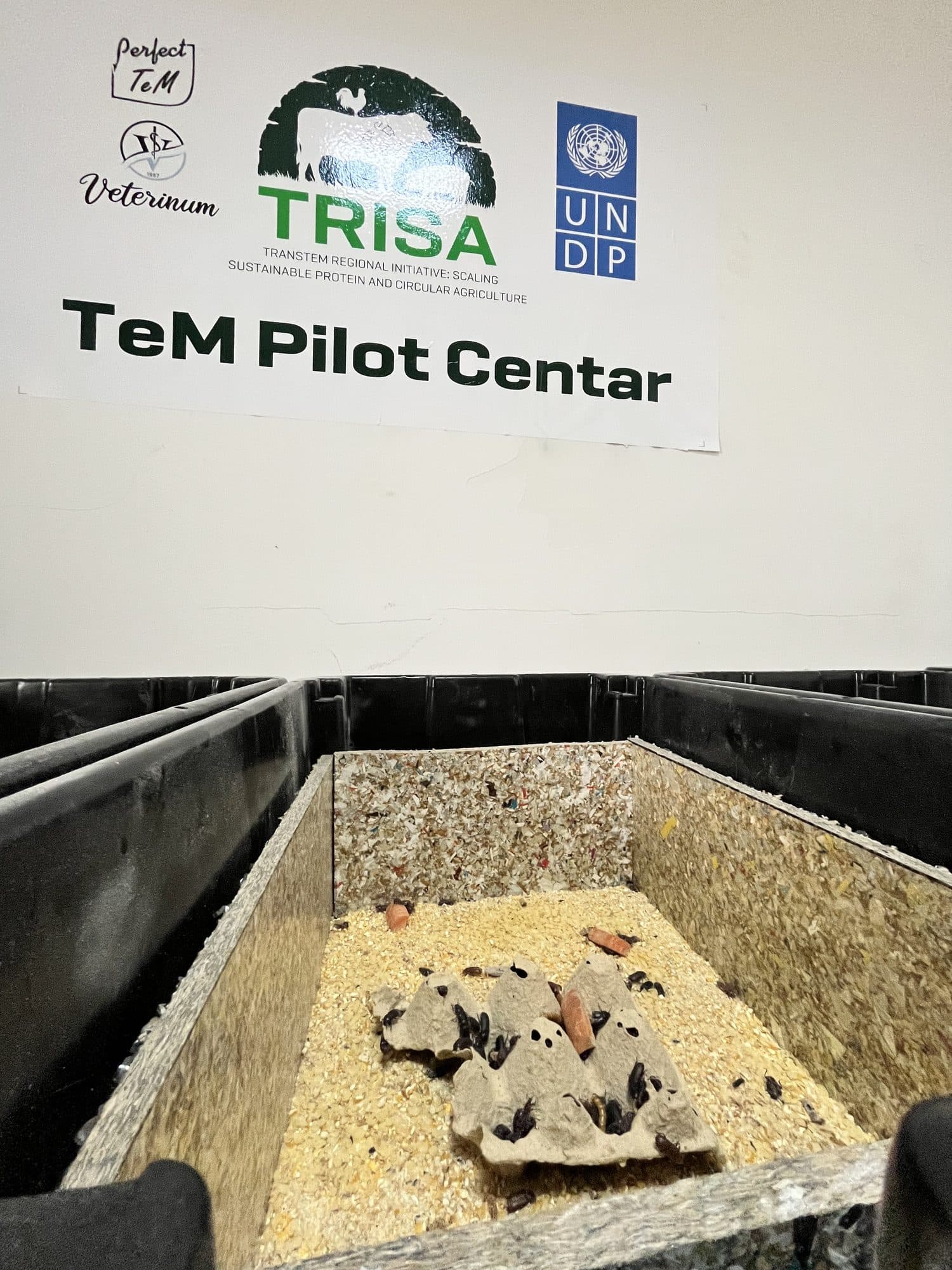
The project was implemented by Belinda Animals in partnership with VU Veterinum, with support provided within Serbia's ODA Challenge Call and by UNDP.


About the project
About the project
TRISA (TransTem Regional Initiative: Scaling Sustainable Protein and Circular Agriculture) was a technology-transfer project through which knowledge on breeding Tenebrio molitor larvae, developed in Serbia, was transferred to Montenegro and put into practice through the establishment of a Pilot Breeding Centre in Ulcinj.
Challenges the project addressed
- Rising and unstable animal-feed costs.
- Dependence on imported protein feed.
- Disrupted regional and international supply chains.
- The need for locally available alternative protein sources.
- The need for circular and resource-efficient agricultural practices.
- Limited practical knowledge of insect breeding in Montenegro.
How the project responded
- Feasibility and market research.
- Adaptation of the technology to local conditions.
- Establishment of a Pilot Breeding Centre.
- Transfer of breeding stock and practical know-how.
- Development of training modules.
- Training of staff, farmers and institutional representatives.
- Daily mentoring.
- Monitoring and site inspections.
- Public communication.
- Initial scaling and product-development research.
Results
Key results
Results achieved during the project implementation period, from January to June 2024.
30 m²
Dedicated, isolated breeding room
22
Training participants
1
Agricultural expert appointed by Veterinum
3
Operational workers assigned to daily activities
5 → 15
Initial batches expanded into active production batches
10
New batches established
~100 g
Fresh larvae produced per week by the end of the pilot phase
2
Formal site inspections
~2 months
Of continuous mentoring
Pilot Breeding Centre
The Tenebrio molitor Pilot Breeding Centre was established at Veterinum's headquarters in Ulcinj, in a dedicated 30 m² room.
Pilot Breeding Centre
- Isolated breeding environment.
- Insulated walls.
- Tiled, easily washable floor and wall surfaces.
- Cleaning and disinfection of the space prior to operation.
- Controlled lighting.
- A full air-conditioning and climate-control system.
- Temperature and humidity sensors.
- Automatic humidification.
- Automatic temperature adjustment.
- Daily environmental monitoring.
- Breeding containers adapted to different lifecycle stages.
- Equipment for feeding, separation, handling and waste (frass) collection.
- Controlled staff access to the space.
- Hygiene and biosecurity procedures.
Target operating conditions
- Temperature: approximately 27–28 °C.
- Relative humidity: approximately 55–60%.
Blackout material was additionally installed on the windows to provide favourable, darker conditions and to reduce solar heat gain in the room.
Training and capacity building
The TRISA training was held on 23 April 2024.
- Date
- 23 April 2024
- Location
- Hotel Barjaktar and Veterinum Headquarters, Ulcinj
- Time
- 09:00–14:30
- Participants
- 22
Participants
- Veterinum management and staff.
- Local workers engaged on the project.
- Representatives of small farms.
- Veterinarians.
- Local-government representatives working in agriculture.
Training programme
- A theoretical workshop.
- Overview of the TRISA project.
- Biology and lifecycle of Tenebrio molitor.
- Abiotic and biotic breeding conditions.
- Preparation and organisation of the breeding space.
- Equipment and materials.
- Feeding.
- Selection of larvae, pupae and adult beetles.
- Reproduction.
- Separation of frass and dead specimens.
- Pest and disease control.
- Hygiene.
- Harvesting.
- Further use and processing of larvae.
- Basic economic and scaling considerations.
Visit to the Pilot Breeding Centre
- All relevant Tenebrio molitor lifecycle stages.
- Live handling procedures.
- Breeding equipment.
- Breeding containers.
- Environmental control systems.
- Practical, day-to-day centre operations.
Participant feedback was positive, with particular value placed on connecting the theoretical part of the training with the live demonstration at the Pilot Breeding Centre.
Project timeline
An overview of key activities from January to June 2024.
- 1
January 2024
Market research, feasibility analysis and local consultations.
- 2
February–March 2024
Technical planning, development of training modules, and preparation of the facility and equipment.
- 3
22 April 2024
Initial formal site inspection.
- 4
23 April 2024
Training, visit to the Pilot Breeding Centre, opening activities and issuance of the Operation Certificate.
- 5
April–June 2024
Daily consultations, mentoring, monitoring and optimisation of centre operations.
- 6
24 June 2024
Follow-up site inspection.
- 7
26 June 2024
Expansion assessment and Expansion Report.
- 8
30 June 2024
Completion of the project implementation period and definition of future scaling directions.
Production and scaling
During the project implementation period, five initial breeding batches developed into fifteen active batches, with ten new batches established.
Egg production increased significantly, and eggs and young larvae were distributed into appropriate containers, creating a foundation for further colony growth.
By the end of the pilot phase, production reached approximately 100 grams of fresh larvae per week.
Pilot-phase output was used for experimental product-development work rather than large-scale commercial sales.
Longer-term direction
- Development into a vertical insect farm.
- An increase in the number of batches and in production volume.
- Establishing Veterinum as a provider of initial Tenebrio molitor colonies.
- Support to other small farms and agricultural companies.
- Development of Tenebrio molitor oil, protein flour and other processed products.
- Further testing and regulatory work before market placement.
Research and product development
Veterinum has existing experience producing specialised bee feed.
Building on that experience, the project initiated early research into the use of fresh or processed Tenebrio molitor larvae as a protein input for bee nutrition.
The activities described above are research, testing and product-development work, and do not represent already-approved commercial products.
Areas of research
- Experimental natural, high-quality protein meals for bees.
- Examination of Tenebrio molitor protein flour.
- Examination of Tenebrio molitor oil.
- Nutritional, safety and formulation analyses.
- Cooperation with laboratories, researchers and competent authorities.
- Obtaining the required analyses, declarations, permits and regulatory confirmations before commercial market placement.
Stakeholder feedback
A summary of impressions from training participants and partners involved in the project.
Veterinum crew
- Valued daily mentoring and practical problem-solving.
- Improved handling, lifecycle-separation and environmental-monitoring skills.
- Gained confidence in managing daily operations independently.
- Identified a need for continued, more advanced training.
Veterinarians
- Were interested in nutritional value, safety and feed applications.
- Emphasised the importance of laboratory analysis and clear regulatory procedures.
- Supported further research into bee and animal nutrition.
Small-farm representatives
- Were interested in small-scale breeding models.
- Saw potential for diversification and local production of protein.
- Requested more practical training and clearer economic models.
- Considered starting with a limited number of colonies.
Local-government representatives
- Recognised the relevance for agricultural innovation, circular economy and local food resilience.
- Emphasised permits, product declarations and regulatory compliance.
- Recommended development of further local support and training programmes.
Serbia's ODA Challenge Call
ODA Challenge Call and replicability
TRISA is an example of practical technology transfer that can be adapted to other environments.
The Tenebrio molitor breeding technology had already been tested and developed in Serbia. It was not simply copied to Montenegro; it was adapted to Veterinum's existing infrastructure, knowledge, market position and bee-feed production activities.
The transfer included infrastructure planning, equipment, initial breeding material, training, daily mentoring, monitoring and support for product development.
As a result, local staff became capable of managing daily breeding operations independently.
The model is modular and does not require a very large initial space, so it can be adapted to other local environments. Successful replication still requires local assessment, training, environmental control, biosecurity and regulatory review.
Future replication possibilities
- Albania.
- Bosnia and Herzegovina.
- North Macedonia.
- Other parts of Montenegro.
- Other Western Balkan markets.
Veterinum's close regional and linguistic connections provide a practical basis for preparing a detailed future technology-transfer initiative for Albania. This initiative is currently under preparation and has not yet been funded or implemented.
Any future replication requires local assessment of conditions, tailored training, environmental-control setup, biosecurity measures and compliance with relevant regulations.
Sustainable Development Goals
The TRISA project contributes to the following United Nations Sustainable Development Goals.
- 2Zero Hunger
- 8Decent Work and Economic Growth
- 9Industry, Innovation and Infrastructure
- 12Responsible Consumption and Production
- 17Partnerships for the Goals
Published and promotional materials
A range of visibility materials was prepared to inform the public and build recognition for the project.
- A detailed instructional presentation on Tenebrio molitor breeding.
- Training curriculum.
- Online project information.
- A media announcement.
- Website updates.
- A roll-up banner.
- An ecological promotional bag.
- A branded pen.
- An A5 agenda.
- A keychain.
- Materials carrying the project, partner and UNDP visual identities.
The ecological promotional bag is a promotional item connected to the sustainability and biodegradation themes addressed by the project.
Contact
For further information about the TRISA project, please contact the implementing organisation and the local project partner.
Belinda Animals DOO
Milivoja Nenadovića 111000 Belgrade, Serbia- Email:
- office@petfood.rs
- Phone:
- +381 63 625327
- Website:
- www.petfood.rs